
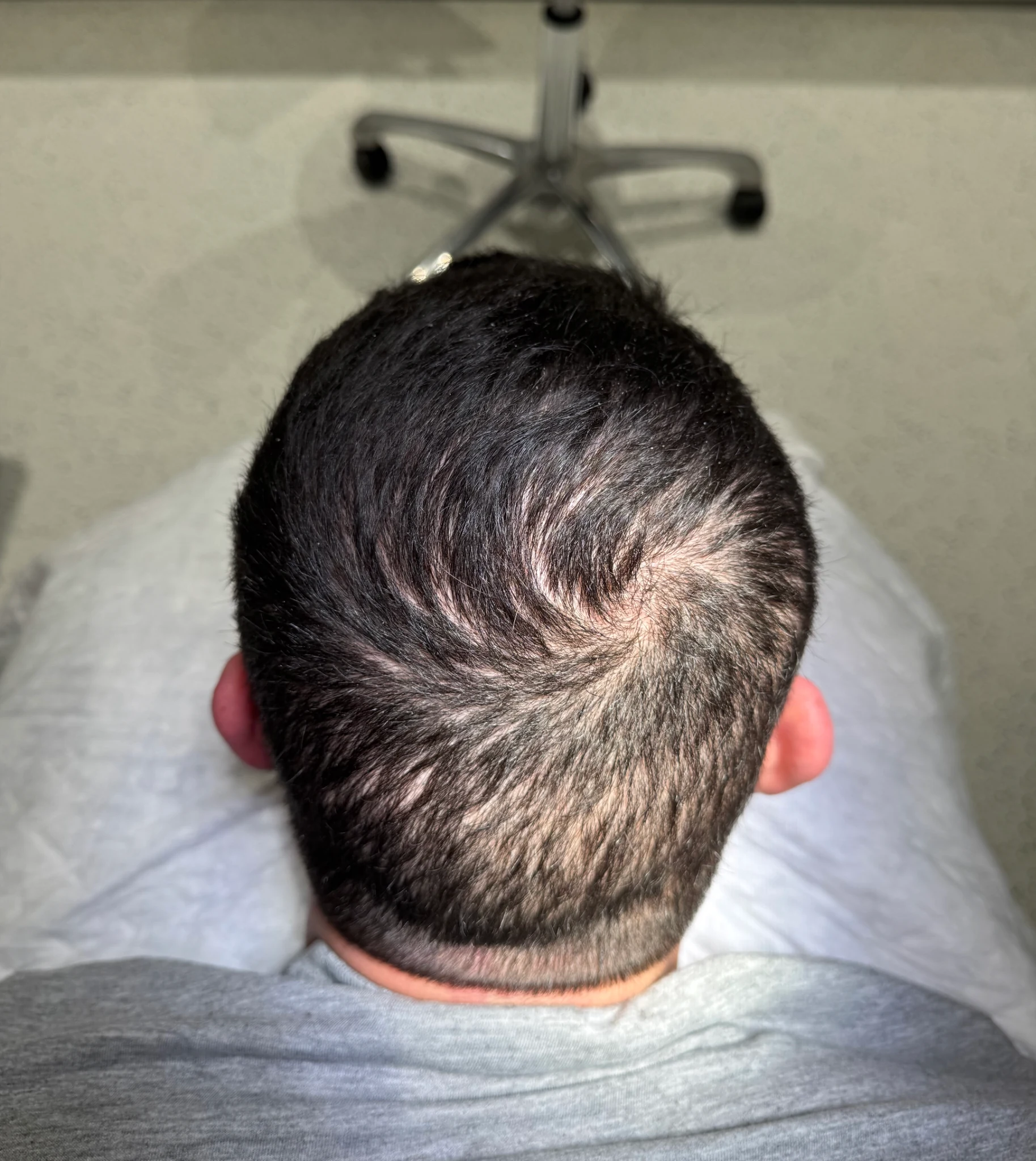
Why can the scalp still be visible?
A transplant redistributes available follicles but does not always achieve uniform visual coverage across the entire area. In addition, native hair around the transplant can continue to change over the years. That is why some patients maintain a good transplant result but still notice thinning in the crown, frontal or top area.
What micropigmentation can add
- Reduce contrast between hair and scalp.
- Visually connect areas with different density.
- Reinforce the crown or top area.
- Camouflage certain scars.
- Visually improve differences in the donor area.
The donor area matters too
After FUE extraction, there may be areas with lower density or small dots that stand out when the hair is worn short. Micropigmentation can help reduce that contrast in suitable cases.
Why I would not treat only “the thin spot”
In many post-transplant cases, treating only the area that causes the most concern can create a difference with adjacent areas. The assessment should consider the frontal area, mid-scalp, crown and donor area as a whole to decide where treatment is actually appropriate.
Micropigmentation and transplant: different, complementary techniques
A hair transplant redistributes follicular units and provides real hair. Micropigmentation does not add hair: it changes the visual perception of the scalp using pigment. Because the two techniques work differently, they can complement each other in selected cases.
Transplanted hair and native hair
Over time, some transplanted hair may remain while the surrounding native hair continues to lose density. The result can be uneven coverage or a scalp that is more visible than it was years earlier. In these cases it does not always make sense to treat only the area that concerns the patient most; the frontal area, top, crown and transition to the donor area should be assessed together.
When can it be done after a transplant?
The scalp and treated areas must be fully healed before they are pigmented. The right timing depends on surgical recovery and skin condition, so a recent transplant requires approval from the medical team responsible before micropigmentation is considered.
Planning when the donor area is limited
When more density cannot be obtained through further extractions, micropigmentation can be considered to visually reduce contrast in certain areas. It does not replace hair, but it can help make the existing result appear more even.
Why density can still look low after a transplant
A transplant redistributes follicular units, but the visual result depends on many factors: treated surface area, hair calibre, contrast with the skin, density achieved and the later evolution of non-transplanted hair. Some patients may still have hair while the scalp remains visible.
Micropigmentation and transplantation can complement each other
They are different procedures. A transplant provides real hair through surgery; micropigmentation works on the visual perception of the background. When correctly indicated, SMP can be used to reduce contrast between hairs or visually integrate certain density differences, without replacing the transplant or altering its biological result.
The donor area is also part of the assessment
After FUE extraction, there may be visible density differences in the back or sides. Not every case requires treatment, but when the scalp stands out between short hairs, specific integration can be considered. If scars or skin changes are present, the tissue response needs particular attention.